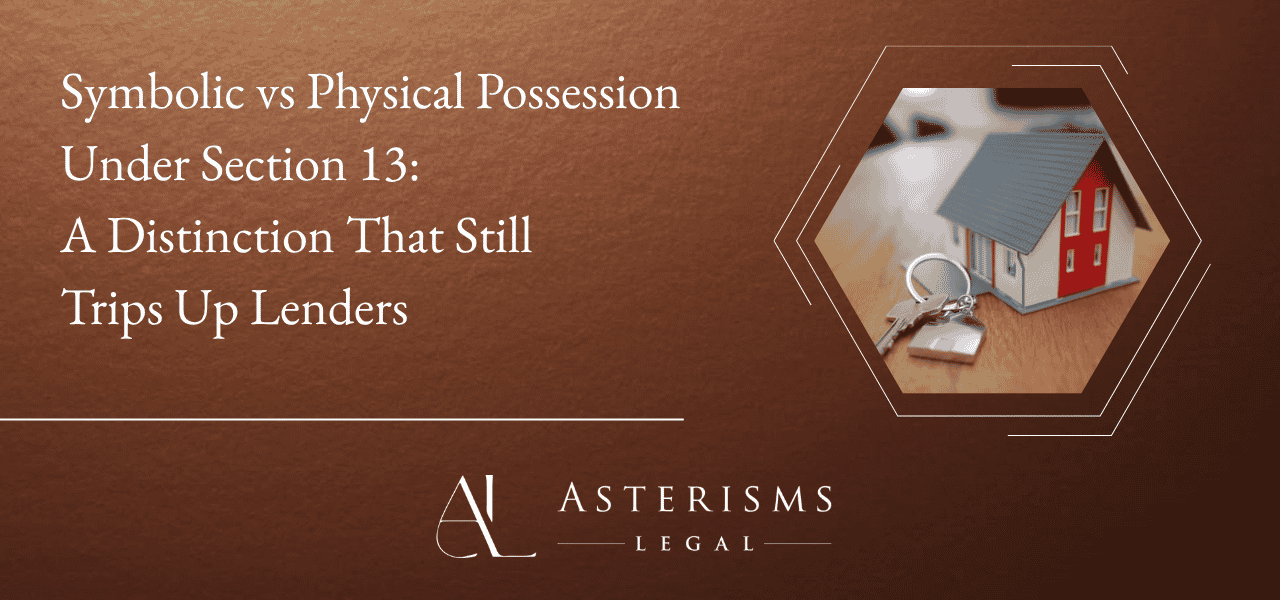
When a secured creditor invokes the SARFAESI Act, one of the most common sources of confusion is the word “possession”. A bank may issue a possession notice, treat itself as having taken possession, and yet the borrower or occupant may remain physically inside the property. That does not necessarily mean the bank has acted without authority. The SARFAESI framework recognises a sequence in which symbolic possession can precede actual physical possession.
What Section 13(4) actually permits
Section 13(2) gives a borrower 60 days to discharge the secured debt after the statutory demand notice. If the borrower fails to do so, Section 13(4) permits the secured creditor to take one or more measures, including taking possession of the secured assets and exercising the right to transfer them by lease, assignment or sale for realisation of the debt.
The Act itself does not use “symbolic possession” and “physical possession” as separate statutory expressions. The distinction emerges from the scheme of the Act and the Security Interest (Enforcement) Rules, 2002, particularly Rule 8. The Supreme Court has expressly accepted symbolic possession as a legally recognised mode of possession under SARFAESI.
How symbolic possession works
For immovable property, Rule 8(1) requires the authorised officer to deliver a possession notice to the borrower and affix it on a conspicuous part of the property. Rule 8(2) also requires publication of the possession notice in two leading newspapers, one of which should be in the vernacular language having sufficient circulation in the locality.
In practical terms, symbolic possession means that the secured creditor asserts possession while the person already occupying the property may continue to remain there for the time being. The creditor does not necessarily have to physically evict the occupant at this stage.
The Supreme Court’s decision in ITC Limited v. Blue Coast Hotels Ltd. is particularly important. The Court rejected the argument that symbolic possession was impermissible under SARFAESI and recognised it as a legally established device. The Court also considered the statutory mechanism for obtaining physical possession after symbolic possession.
Physical possession is a different step
Physical possession means actual control and delivery of the secured asset. Where the borrower or another occupant does not voluntarily hand over possession, the secured creditor may seek assistance under Section 14 of SARFAESI from the Chief Metropolitan Magistrate or District Magistrate, as applicable.
Where the property is occupied, a bank cannot treat a possession notice as a licence to use force or bypass the statutory machinery. Section 14 facilitates the taking of possession through the Magistrate when assistance is required. The Supreme Court has recognised the legality of symbolic possession while separately addressing the mechanism through which actual possession can be secured.
Does symbolic possession allow the bank to sell?
Yes, subject to compliance with the SARFAESI Act and Rules. Symbolic possession is not legally meaningless merely because the property remains occupied.
The Supreme Court has explained that Rule 8 contemplates possession before the sale process and does not make physical possession an absolute precondition to every sale. In ITC Limited, the Court held that the statutory scheme did not render symbolic possession illegal.
But lenders should not confuse the power to sell with an automatic ability to deliver vacant physical possession. Those are separate practical issues. An auction purchaser may acquire rights through the sale certificate while still needing the statutory process for obtaining actual possession where the property is occupied.
Why the distinction matters to borrowers and lenders
The distinction also affects transaction planning. A lender marketing an occupied property should disclose the possession position accurately and avoid creating the impression that vacant possession is guaranteed when it has only symbolic possession. Prospective purchasers should examine the possession notice, sale terms and any pending DRT or Section 14 proceedings before bidding.
For borrowers, symbolic possession is already a measure under Section 13(4). It is therefore not advisable to wait until physical eviction before considering a challenge. Section 17 provides the statutory remedy before the DRT against measures taken under Section 13(4).
For lenders, procedural compliance is equally important. A defective possession notice, inadequate publication, or an attempt to obtain possession outside the prescribed mechanism can expose the recovery action to challenge.
The position becomes more sensitive where third-party occupants claim tenancy or other independent rights. In PNB Housing Finance Limited v. Manoj Saha, decided by the Supreme Court in July 2025, the Court dealt with a tenant’s challenge after symbolic and subsequently physical possession had been taken. The judgment emphasised that, following the 2016 amendment introducing Section 17(4A), persons claiming to be lessees or tenants have a statutory route before the DRT to challenge measures under Section 13(4), with an appeal available under Section 18.
A practical checklist for lenders
Before treating symbolic possession as complete, lenders should verify that the Section 13(2) process has been properly completed, objections under Section 13(3A) have been dealt with as required, and the Rule 8 possession-notice requirements have been satisfied.
They should then distinguish clearly between three things: taking symbolic possession, conducting the sale, and obtaining physical possession. Each has its own procedural consequences.
Where physical possession is resisted or cannot be obtained voluntarily, the safer course is to use Section 14 rather than attempt self-help. Documentation should also be consistent throughout the recovery process, particularly where the property is occupied by someone other than the borrower.
The bottom line
Symbolic possession is not a weaker or unofficial version of SARFAESI possession. It is a recognised legal step that can protect the secured creditor’s position and enable the enforcement process to move forward even when physical possession has not yet been obtained.
At the same time, symbolic possession should not be treated as equivalent to vacant physical possession. For lenders, that distinction is crucial when planning an auction and managing delivery of the asset. For borrowers and occupants, it determines when a statutory remedy may be invoked and what procedural safeguards remain available.
The safest approach is to treat possession as a staged statutory process, not as a single event. That is where many SARFAESI disputes are won or lost.